
IndianScribes

  • Transcription
  • Writing
  • FAQ
  • Contact
  • Blog
IS on Twitter

Outsourcing Transcription of Research Interviews

Written by admin on November 11, 2009 - 1 Comment

When planning to outsource the transcription of your research interviews it may be a good idea to invest some time in writing out a clear set of instructions for your transcriptionist because research transcription is quite different from regular transcription. Here are a few points to get you started -

Identify the Transcription Style

In research interviews the HOW of what’s being said is almost as important as the WHAT. For this reason the preferred style of transcription for these interviews is Verbatim Transcription. This style involves typing out everything that’s recorded on the interview including -

  • Fillers (the ums, ahs, you knows, etc.)
  • False starts, i.e. sentences that are started but then changed to something else (For e.g., “I think that would be…I’d say that’s something important”).
  • Repeated words/phrases (e.g., “in that case, in that case the methodology would differ”)
  • Non-verbal communication (such as laughter, long pauses, coughing, etc.)
  • Other observations from the recording such as side conversations, over talking, interruptions, people walking in or out, etc.

The alternative style of transcription is Clean Read. This style is not used in research transcription as it involves editing out some part of the text.

Provide Formatting Guidelines

If everything on a recording is typed out in a single chunk of text, it would be impossible to decipher anything of value from the transcript. And you as the end-user of the transcript would end up spending hours trying to figure out where one speaker stopped and the next one began speaking! To avoid this, provide some basic guidelines to your transcriptionist, such as -

Paragraphing

The entire transcript should be broken down into small paragraphs for ease of reading. This of course doesn’t mean unnecessarily changing paragraphs even if it’s contextually incorrect – but common sense should be used to break down long monologues.

Speaker Identification

The initials/first name/full name should be mentioned each time the speaker changes. This can also be marked in bold for easy identification. The speech of the interviewer and interviewee/s can also be differentiated by using italicized text for one of them.

Using italics or brackets for emphasis

Italics can be used to mark text that is spoken with particular emphasis. Some people prefer to use [brackets] or text in bold for this purpose.

Time stamping

A 100% accurate transcript is a myth. No matter how skilled a transcriptionist, there would always be some words that are unclear or inaudible on a recording. These should be time stamped [hh:mm] or [hh:mm:ss] and highlighted for easy identification while editing. You can then quickly play just that portion of the recording and make the necessary corrections when reviewing the transcript.

Other customized formatting

Some people like to add customized formatting such as-

‘…’ for short pauses

[duration] for long pauses

/ for one speaker finishing of a sentence started by another, etc.

These instructions should be clearly documented and shared with the transcriptionist before beginning transcription.

Test Accuracy

Accuracy of course is crucial in research transcription (a minimum of98.5%). To find out how accurate your transcripts are going to be, it’s a good idea to ask your transcriptionist to complete one interview as a test. Most transcription companies charge for samples and you may have to invest a small amount in testing the skills of several service providers. But in the long run this would pay off in terms of both time and money spent on getting the transcripts proofed by someone else.

Research Prices

Most PhD students and Research Associates work on small budgets. The expenses for transcription are either paid out of their own pockets or through limited-amount grants from their college/university/institute. Keeping this in mind, most transcription companies offer discounts on research transcription that can be availed by provide a copy of a college ID card or other documents that prove that you’re a student.

That said, research transcription does require considerably more effort as compared to other types of transcription (such as business transcription). As such transcription rates for research interviews normally range between $25.00 – $55.00 per audio hour. The cost can vary depending on several factors (including where you’re outsourcing to). It’s a good idea to ask for a quote from several service providers to compare prices.

Discuss Confidentiality

Be sure to ask the service provider to provide a signed NDA that clearly states that the material (interviews as well as transcripts) will be kept confidential and deleted at the end of the project. Most good transcription companies provide these options proactively, but it’s still a good idea to outline (and document) your requirements before beginning work.

Review Often

If you choose the services of a new transcription company (or one you’re hiring for the first time), it would be a good idea to review the transcripts periodically rather than waiting till all the interviews have been transcribed.

Did you find this post useful? Leave a comment or ask a question!

1 Comment

Using Directional Microphones for Recording Speech
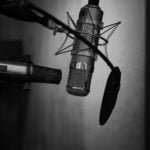
Written by admin on November 7, 2009 - 1 Comment

A microphone can pick up sounds from all directions or a specific direction depending on its technical built. This sensitity to sound from one or more directions is called Directionality. Based on this property, there are 3 main types of microphones available -

Omnidirectional Microphones

Unidirectional Microphones

Bidirectional Microphones

Omnidirectional Microphones

These microphones pick up sounds from all directions and are generally used only when there are multiple speakers involved in a recording (as would be in the case of a conference or meetings).

These microphones are not recommended for recording the speech of a single speaker unless you’re recording in a quite room with little or no surrounding noise. This is because omnidirectional microphones capture sounds from all directions and therefore a lot of unwanted sounds such as shifting chairs, doors opening, side conversations, vehicles passing by, etc. can also get recorded.

When using an omnidirectional microphone in an indoors setting, it’s a good idea choose a quiet room and lay down some ground rules for the participants before beginning recording. When outdoors, the microphone should be placed as close to the speaker as possible.

Unidirectional Microphones

These microphones pick up sounds from a single direction – i.e. the direction they’re facing. There are 2 major types of unidirectional microphones -

Shotgun Microphones

Shotgun microphones are best for outdoor recordings because they have a very narrow ‘angle of acceptance’ or ‘pickup pattern’ or simply put, the area from which they pick up sound. This means they can pick up the particular sound they’re directly towards and reject all other surrounding noise to produce a very clear recording.

Long shotgun microphones provide the highest level of directionality and pick up sound from only the person/object that they’re pointed at. This leads to a very high quality of recording and makes them ideal for noisy locations.

The downside of using these microphones is that since they’re very long (and often used with a boom), they normally need a second person to operate. Also, the microphone must consistently be pointed directly towards the speaker – any movement away from the speaker will result in an interruption of the flow of sound to the microphone and thereby impact the recording.

Short shotgun microphones are, well, shorter. Their properties are similar to the long shotgun microphones, the only difference lying in the slightly wider ‘angle of acceptance’ of the short shotgun. They are more portable as well; this makes them the microphones of choice for outdoor recordings that require a degree of mobility – such as interviews conducted on the street.

Shotgun microphones are especially useful when the speaker is not close to the microphone. The more the distance between the speaker and the microphone, the more directional the microphone needs to be.

Cardioid Microphones

Cardioid microphones are the ones used most commonly for speech recording. That’s because they are directional like the shotgun microphones yet offer flexibility in terms of the ‘angle of acceptance’ as well as size and portability.

They pick up sound mainly from the direction that they’re pointed in, some from the far sides of the microphone, and very little from behind the microphone. Since they’re unidirectional, they eliminate a lot of surrounding noise and produce high quality recordings.

Bidirectional Microphones

As the name suggests, these bidirectional microphones pick up sounds from two opposite directions and reject sound from other sides. Also known as figure-of-eight microphones, these microphones are useful for recording two-person interviews where two people are seated on the opposite sides of a table. Bidirectional microphones are not very commonly used because of their limited application.

Some microphones come with multiple options that allow users to switch from let’s say cardioid to omnidirectional mode when required.

1 Comment

What is clean read transcription?

Written by admin on November 7, 2009 - 4 Comments

Clean read or intelligent verbatim transcription focuses on typing out the essence of what’s being said on a recording rather than the absolute and exact words. This means that the transcript is edited to remove any fillers (ums, ahs, you knows, etc.), false starts, repeated words, side conversations, interruptions, and other speech/sounds irrelevant to the transcript. For e.g.,

Original transcript- “The idea you know is to take…is to place your umm.. business er…right at the…where your customers can you know see it”

Clean read transcript – “The idea is to place your business where your customers can see it”

The main idea is to create an easy-to-read, intelligent transcript that captures everything that’s important and leaves out the parts that are not relevant.

Clean read transcription is ideal for teleclasses, lectures, presentations, non-research interviews, podcasts, and conferences. It’s perfect for creating content that’s can be published as it is.

Tell your transcriptionist that you’re looking for a ‘clean’ transcript at the beginning of a project. The transcriptionist will then clean out the transcript as much as possible right in the first round of typing and will then take it through another round of editing to create an easy flowing, intelligent transcript of your audio/video.

Refer to Verbatim Transcription to learn about transcripts that document everything that’s recorded.

4 Comments

Microphones: Reading the spec sheet

Written by admin on November 3, 2009 - 0 Comments

Are you planning to record an interview, lecture, teleseminar, conference, or some other event involving speech?  It’s been said that a recording can only be as good as the microphone that’s used – and the statement is absolutely true. Choosing the right microphone is as crucial as choosing the right recording device.
The choice of microphone for a recording depends on several factors such as location (indoors/outdoors), number of speakers, distance of the microphone from the speaker/s, etc. In this post we’ll look at some key properties of a microphone that should be considered before making a purchase.
Diaphragms
Every microphone has diaphragm i.e. a thin membrane of plastic, aluminium, or paper located in the head of the microphone that vibrates when hit by sound waves. Vibration of the diaphragm leads to movement in other parts of the microphone that generate electrical signals (or audio signals) that can be recorded. We’ll discuss the ‘other parts’ and their movement in a minute. There are 3 types of diaphragms – large, medium, and small – that differ in diameter.
Large diaphragms have diameters ranging from 3/4 inch upto to 1 inch and sometimes more. Their large surface area and comparitively flexible surface makes them more sensitive to sound. Because of their construct, they also have lesser ‘self-noise’ i.e. noise added to the recording by the microphone’s internal sounds. But while the general sound quality is quite decent, they don’t capture higher frequencies very well.
Small diaphragms (with diameters 5/8 inch or less) are lighter and therefore more responsive to higher frequencies. When sound waves strike a diaphragm from the side, they take time to travel across it’s body. If the diaphragm is large, the time taken to travel across will be longer and may result in loss of vibrations leading to reduced quality. That’s why large diaphragms work best when the sound waves strike from directly in front rather than the sides. With small diaphragms the loss of vibrations is negligible and therefore the sound quality is sharper no matter which direction the sound is coming from.
Transducers
A transducer is a device that converts one form of energy to another. Tehcnically speaking, microphones are transducers that convert accoustic energy (sound waves) to electrical energy. Based on the kind of transducer used, there are 4main types of microphones available – Dynamic, Condenser, Ribbon, and Crystal. Dynamic and Condenser are the most widely used.
Dynamic Microphones
These simple, rugged microphones work on the principle of electromagnetism. When sound waves hit the the diaphragm of a dynamic microphone, the vibration makes a coil of wire (or a ribbon of metallic foil) move back and forth against a fixed magnet. This creates electric current or audio signals that can be recorded.
Dynamic microphones are simply constructed and sturdy. They don’t require an external battery or other power source to operate and compartively less expensive. They can handle high sound pressure levels without distortion but can’t capture high frequencies very well due to their mechanical construct. Ideal for rough use in live performances and on location recordings.
Condenser Microphones
These sensitive microphones work on the principle of capacitance (the ability of a body to hold electrical charge). Condenser (aka capacitor) microphones consist of two plates formed by a thin conductive diaphragm and a metallic back plate – these together form a capacitor. A fixed charge is placed across this capacitor through an external power source such as a battery or a phantom power supply. When the diaphragm vibrates under the force of sound waves, there are fluctuations in the capacitance leading to changes in voltage between the plates (voltage being inversely propotional to capacitance and capacitance being inversely proportional to the distance between the plates). These changes in voltage can then be recorded.
Condenser microphones are sensitive to a wider range of frequencies and can pick up softer sounds. They also have a flatter frequency response. The downside is that they are fragile and therefore unsuitable for rough use. They are also quite expensive. Best for in studio or home recordings.
Directionality
A microphone can pick up sounds from all directions or a specific direction depending on its technical built. This sensitity to sound from one or more directions is called Directionality. Based on this property, there are 3 main types of microphones available in the market -
Omnidirectional Microphones
Directional or Unidirectional Microphones
Bidirectional Microphones
Omnidirectional Microphones
These microphones pick up sounds from all directions and are generally not recommended for recording speech. That said, they’re a reasonably good choice when recording the voices of a large number of people together – such as a conference where several people are seated around a table.
Because of the simplicity of their design, omnidirectional microphones are considered more rugged and produce a more ‘natural’ sound recording (as compared to bidirectional/unidirectional microphones). They are also less sensitive to wind/pop noises, resulting in clearer recordings. The drawback is that because they record sounds from all directions, a lot of unwanted sounds such as shifting chairs, doors opening, side conversations, vehicles passing by, etc. can also get recorded.
When using an omnidirectional microphone in an indoors setting, it’s a good idea choose a quiet room and lay down some ground rules for the participants before beginning recording. When outdoors, the microphone should be placed as close to the speaker as possible.
Directional (aka Unidirectional) Microphones
These microphones pick up sounds from a single direction – though single is a relative term. There are 3 major categories of directional (or unidirectional) microphones -
Shotgun Microphones
These come in two varieties – the long shotgun and the short shotgun microphone. These microphones are best for outdoor recordings because they have a very narrow ‘angle of acceptance’ or ‘pickup pattern’ or simply put, the area from which they pick up sound. This means they can pick up the particular sound they’re directly towards and reject all other surrounding noise to produce a very clear recording.
Long shotgun microphones provide the highest level of directionality and pick up sound from only the person/object that they’re pointed at. This leads to a very high quality of recording and makes them ideal for noisy locations. The downside of using these microphones is that since they’re very long (and often used with a boom), they normally need a second person to operate. Also, the microphone must consistently be pointed directly towards the speaker – any movement away from the speaker will result in an interruption of the flow of sound to the microphone and thereby impact the recording.
Short shotgun microphones are, well, shorter. Their properties are similar to the long shotgun microphones, the only difference lying in the slightly wider ‘angle of acceptance’ of the short shotgun. They are more portable as well; this makes them the microphones of choice for outdoor recordings that require a degree of mobility – such as interviews conducted on the street.
The high level of directionality of shotgun microphones is especially useful when the subject is not close to the microphone. The more the distance between the speaker and the microphone, the more directional the microphone needs to be.
Cardioid Microphones
Cardioid microphones are the ones most commonly used for speech recording. That’s because they are directional like the shotgun microphones yet offer flexibility in terms of the ‘angle of acceptance’ as well as size and portability. They come in 3 varities – cardioid, hypercardioid, and supercardioid.
Cardioid microphones are considered best for recordings that involve a large number of speaker (as long as they’re seated within the pickup range and direction of the microphone). They pick up sound mainly from the direction that they’re pointed in, some from the far sides of the microphone, and very little from behind the microphone. Since they’re unidirectional, they eliminate a lot of surrounding noise and produce high quality recordings.
Hypercardioid microphones are a step higher than the cardioids in terms of directionality. They have a narrower angle of acceptance and are very effective in eliminating noise from the rear of the microphone. The Supercardioid microphones on the other hand, eliminate more of the sounds from the sides of the microphone than from the rear.
The hypercardioid and the supercardioid microphones offer a high level of directionality (though lesser than the shotgun microphones) along with portability. Also, they don’t need to be pointed directly towards the speaker and therefore offer more flexibility of movement both for the microphone and the speaker.
Bidirectional Microphones
As the name suggests, these microphones pick up sounds from two opposite directions and reject sound from other sides. Also known as figure-of-eight microphones, these microphones are useful for recording two-person interviews where two people are seated on the opposite sides of a table. Bidirectional microphones are not very commonly used because of their limited application.
Some microphones come with multiple options that allow users to switch from let’s say cardioid to omnidirectional mode when required.
Frequency response
This property relates to the accuracy with which a microphone reproduces a range of sound frequencies. For example, a frequency reponse of 50-14Khz +/-3db indicates that the microphone covers frequencies between 50-14,000hz with a variation in volume not exceeding 3 decibles.
A microphone with a poor response to high frequencies will produce dull sounds while one with a poor response to low frequencies will sound tinny. In an ideal world, microphones would have a flat frequency response, i.e., the sound output will be exactly the same as the original sound input. However, this is never the case because no microphone is perfectly flat. A variation of +/-3db is common.
Impedence
Every circuit offers some level of resistance to alternating current (or audio signals) know as impedence. The lower the impedence of a microphone the better the quality of the recording. Most microphones are low-impedence, but when reading a spec sheet, here’s the general description to go by -
Less than 600Ω – Low impedence
600Ω – 10,000Ω – Medium impedence
Greater than 10,000Ω – High impedence
High impedence microphones are cheaper but their audio quality over long distance is not so great – leading to loss of high frequencies over long cables. Low impedence microphones are generally considered better.
Okay, so that was about the basic properties of a microphone. While this post is not exhaustive, it should make it easier for you to read a ‘spec sheet’ when you go out to buy a microphone. In the next post, we’ll cover some common types of microphones.
In the meanwhile, happy recording!

Are you planning to record an interview, lecture, teleseminar, conference, or some other event involving speech?  It’s been said that a recording can only be as good as the microphone that’s used – and the statement is absolutely true. Choosing the right microphone is as crucial as choosing the right recording device.

The choice of microphone for a recording depends on several factors such as location (indoors/outdoors), number of speakers, distance of the microphone from the speaker/s, etc. In this post we’ll look at some key properties of a microphone that should be considered before making a purchase.

Diaphragms

Every microphone has diaphragm i.e. a thin membrane of plastic, aluminium, or paper located in the head of the microphone that vibrates when hit by sound waves. Vibration of the diaphragm leads to movement in other parts of the microphone that generate electrical signals (or audio signals) that can be recorded. We’ll discuss the ‘other parts’ and their movement in a minute. There are 3 types of diaphragms – large, medium, and small – that differ in diameter.

Large diaphragms have diameters ranging from 3/4 inch upto to 1 inch and sometimes more. Their large surface area and comparitively flexible surface makes them more sensitive to sound. Because of their construct, they also have lesser ‘self-noise’ i.e. noise added to the recording by the microphone’s internal sounds. But while the general sound quality is quite decent, they don’t capture higher frequencies very well.

Small diaphragms (with diameters 5/8 inch or less) are lighter and therefore more responsive to higher frequencies. When sound waves strike a diaphragm from the side, they take time to travel across it’s body. If the diaphragm is large, the time taken to travel across will be longer and may result in loss of vibrations leading to reduced quality. That’s why large diaphragms work best when the sound waves strike from directly in front rather than the sides. With small diaphragms the loss of vibrations is negligible and therefore the sound quality is sharper no matter which direction the sound is coming from.

Transducers

A transducer is a device that converts one form of energy to another. Technically speaking, microphones are transducers that convert accoustic energy (sound waves) to electrical energy. Based on the kind of transducer used, there are 4main types of microphones available – Dynamic, Condenser, Ribbon, and Crystal. Dynamic and Condenser are the most widely used.

  • Dynamic Microphones

These simple, rugged microphones work on the principle of electromagnetism. When sound waves hit the the diaphragm of a dynamic microphone, the vibration makes a coil of wire (or a ribbon of metallic foil) move back and forth against a fixed magnet. This creates electric current or audio signals that can be recorded.

Dynamic microphones are simply constructed and sturdy. They don’t require an external battery or other power source to operate and compartively less expensive. They can handle high sound pressure levels without distortion but can’t capture high frequencies very well due to their mechanical construct. Ideal for rough use in live performances and on location recordings.

  • Condenser Microphones

These sensitive microphones work on the principle of capacitance (the ability of a body to hold electrical charge). Condenser (aka capacitor) microphones consist of two plates formed by a thin conductive diaphragm and a metallic back plate – these together form a capacitor. A fixed charge is placed across this capacitor through an external power source such as a battery or a phantom power supply. When the diaphragm vibrates under the force of sound waves, there are fluctuations in the capacitance leading to changes in voltage between the plates (voltage being inversely propotional to capacitance and capacitance being inversely proportional to the distance between the plates). These changes in voltage can then be recorded.

Condenser microphones are sensitive to a wider range of frequencies and can pick up softer sounds. They also have a flatter frequency response. The downside is that they are fragile and therefore unsuitable for rough use. They are also quite expensive. Best for in studio or home recordings.

Directionality

A microphone can pick up sounds from all directions or a specific direction depending on its technical built. This sensitity to sound from one or more directions is called Directionality. Based on this property, there are 3 main types of microphones available in the market -

Omnidirectional Microphones

Directional or Unidirectional Microphones

Bidirectional Microphones

  • Omnidirectional Microphones

These microphones pick up sounds from all directions and are generally not recommended for recording speech. That said, they’re a reasonably good choice when recording the voices of a large number of people together – such as a conference where several people are seated around a table.

Because of the simplicity of their design, omnidirectional microphones are considered more rugged and produce a more ‘natural’ sound recording (as compared to bidirectional/unidirectional microphones). They are also less sensitive to wind/pop noises, resulting in clearer recordings. The drawback is that because they record sounds from all directions, a lot of unwanted sounds such as shifting chairs, doors opening, side conversations, vehicles passing by, etc. can also get recorded.

When using an omnidirectional microphone in an indoors setting, it’s a good idea choose a quiet room and lay down some ground rules for the participants before beginning recording. When outdoors, the microphone should be placed as close to the speaker as possible.

  • Directional (aka Unidirectional) Microphones

These microphones pick up sounds from a single direction – though single is a relative term. There are 3 major categories of directional (or unidirectional) microphones -

  • Shotgun Microphones

These come in two varieties – the long shotgun and the short shotgun microphone. These microphones are best for outdoor recordings because they have a very narrow ‘angle of acceptance’ or ‘pickup pattern’ or simply put, the area from which they pick up sound. This means they can pick up the particular sound they’re directly towards and reject all other surrounding noise to produce a very clear recording.

Long shotgun microphones provide the highest level of directionality and pick up sound from only the person/object that they’re pointed at. This leads to a very high quality of recording and makes them ideal for noisy locations. The downside of using these microphones is that since they’re very long (and often used with a boom), they normally need a second person to operate. Also, the microphone must consistently be pointed directly towards the speaker – any movement away from the speaker will result in an interruption of the flow of sound to the microphone and thereby impact the recording.

Short shotgun microphones are, well, shorter. Their properties are similar to the long shotgun microphones, the only difference lying in the slightly wider ‘angle of acceptance’ of the short shotgun. They are more portable as well; this makes them the microphones of choice for outdoor recordings that require a degree of mobility – such as interviews conducted on the street.

The high level of directionality of shotgun microphones is especially useful when the subject is not close to the microphone. The more the distance between the speaker and the microphone, the more directional the microphone needs to be.

  • Cardioid Microphones

Cardioid microphones are the ones most commonly used for speech recording. That’s because they are directional like the shotgun microphones yet offer flexibility in terms of the ‘angle of acceptance’ as well as size and portability. They come in 3 varities – cardioid, hypercardioid, and supercardioid.

Cardioid microphones are considered best for recordings that involve a large number of speaker (as long as they’re seated within the pickup range and direction of the microphone). They pick up sound mainly from the direction that they’re pointed in, some from the far sides of the microphone, and very little from behind the microphone. Since they’re unidirectional, they eliminate a lot of surrounding noise and produce high quality recordings.

Hypercardioid microphones are a step higher than the cardioids in terms of directionality. They have a narrower angle of acceptance and are very effective in eliminating noise from the rear of the microphone. The Supercardioid microphones on the other hand, eliminate more of the sounds from the sides of the microphone than from the rear.

The hypercardioid and the supercardioid microphones offer a high level of directionality (though lesser than the shotgun microphones) along with portability. Also, they don’t need to be pointed directly towards the speaker and therefore offer more flexibility of movement both for the microphone and the speaker.

  • Bidirectional Microphones

As the name suggests, these microphones pick up sounds from two opposite directions and reject sound from other sides. Also known as figure-of-eight microphones, these microphones are useful for recording two-person interviews where two people are seated on the opposite sides of a table. Bidirectional microphones are not very commonly used because of their limited application.

Some microphones come with multiple options that allow users to switch from let’s say cardioid to omnidirectional mode when required.

Frequency response

This property relates to the accuracy with which a microphone reproduces a range of sound frequencies. For example, a frequency reponse of 50-14Khz +/-3db indicates that the microphone covers frequencies between 50-14,000hz with a variation in volume not exceeding 3 decibles.

A microphone with a poor response to high frequencies will produce dull sounds while one with a poor response to low frequencies will sound tinny. In an ideal world, microphones would have a flat frequency response, i.e., the sound output will be exactly the same as the original sound input. However, this is never the case because no microphone is perfectly flat. A variation of +/-3db is common.

Impedence

Every circuit offers some level of resistance to alternating current (or audio signals) know as impedence. The lower the impedence of a microphone the better the quality of the recording. Most microphones are low-impedence, but when reading a spec sheet, here’s the general description to go by -

Less than 600Ω – Low impedence

600Ω – 10,000Ω – Medium impedence

Greater than 10,000Ω – High impedence

High impedence microphones are cheaper but their audio quality over long distance is not so great – leading to loss of high frequencies over long cables. Low impedence microphones are generally considered better.

Okay, so that was about the basic properties of a microphone. While this post is not exhaustive, it should make it easier for you to read a ‘spec sheet’ when you go out to buy a microphone. In the next post, we’ll cover some common types of microphones.

In the meanwhile, happy recording!

  • Recent Posts

    • 5 Ways the Transcript of a Teleseminar Can Be Used to Improve Business
    • Interview Transcription Check-list
    • How to Transcribe a Focus Group
    • Factors that Affect Transcription Rates
    • 4 Rules of Verbatim Transcription
  • Categories

    • Audio Recording
    • Latest
    • Transcription

About Us | Privacy Policy | Contact
IndianScribes on LinkedIn

Powered by frugal


Copyright © 2010 IndianScribes